AI Won't Kill Advertising's Brand Creativity. It's Already Dead.
Brand creativity thrived for 30 years after “Think Small,” then declined for 30 more because its outcomes were never defined or priced. Outcomes give it a real chance to be reborn.
October 22, 2026
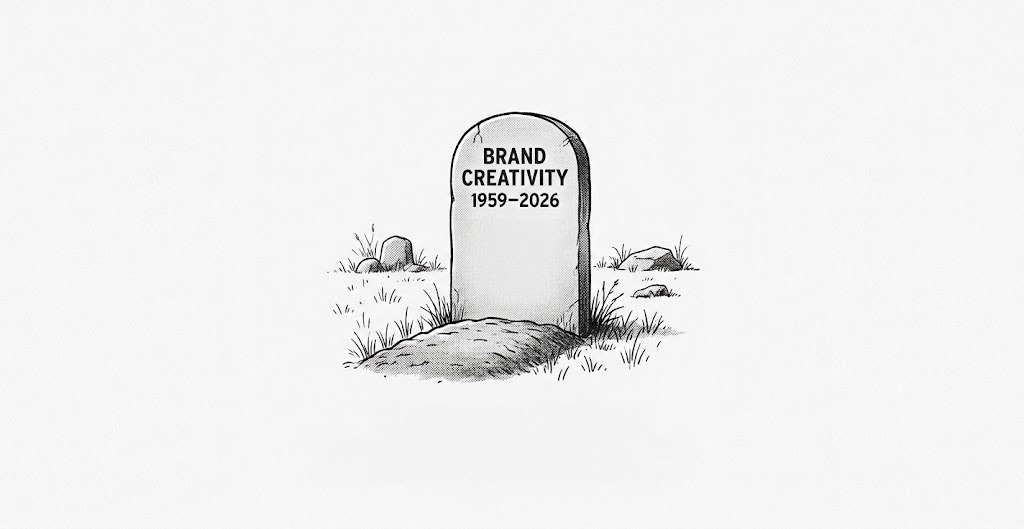
The tombstone reads 1959 because that's the year VW first ran “Think Small” by DDB, an agency that also died recently. I mark it as the moment brand creativity showed what it could do for a business. Brand creativity thrived for 30 years from that point but has been in decline since the early 1990s, and in 2026 I think it's fair to pronounce it dead.
How it died
In the early 1990s, the people running public companies and major advertisers didn't financially embrace brand creativity's strength, or its ability to multiply spend. To give them the benefit of the doubt, they couldn't. At the time, its outcomes couldn't be measured the way media's could. Because they couldn't be measured, they weren't defined or priced. So the easiest decision for holding companies and CMOs was to set brand creativity on a path to a slow death over the next 30 years, while embracing the coming scale of media and the technology-driven surge of performance marketing.
Why? Because media had defined and priced market outcomes.
Brand creativity didn't. Still doesn't.
It's in this position because its financial contribution, its outcomes, has never been financially defined.
It has mostly been “believed in” by a core group of strategists, researchers and practitioners who pointed to its correlation with commercial outcomes.
Without credible, aggregated outcome measurement, it's remarkable it lasted as long as it did. Perhaps that alone suggests its strength has always been misunderstood.
Three things killed it.
First, the rules of public-company share prices.
Second, procurement's empowerment to cut its price by 75% over 30-plus years, as Michael Farmer has documented.
Third, and most critically, the industry's own failure to define and defend its contribution to growth.
Outcomes are commercial oxygen today, and brand creativity doesn't have any.
What suggests its 2026 death?
Nike has favored performance marketing over brand for several years now, and its share price has dropped more like a meme coin than a global brand leader's. Its marketing has looked like Apple's in the early 1990s, after Steve Jobs was pushed out. And speaking of Apple, it is now listing features in its ads in a way not seen since it was nearly bankrupt in that same decade. Its advertising hasn't been special for some time. Apple is one of the two most valuable companies on the planet, but that value has more to do with its closed system than its advertising in recent years. When brand creativity is this conspicuously missing from two companies that once led the way in showing what it could do, I think that's a fair indication it's dead as a desired service and a leading business.
Super Bowl advertising over the last 15 years has mostly, with occasional exceptions, been unoriginal: indistinct celebrity mash-ups and stunts with little strategic or creative substance. The standard was poor long before now. As Andrew Robertson, now CEO of Omnicom Advertising, said in 2012 at an ANA Financial Conference, more than 70% of the work Ipsos tested was rated poor or average. If that was the standard then, after more than another decade of cuts and reduced investment, it's fair to assume it's worse now, not better.
Brand creativity is no longer a significant revenue line at most holding companies, under 20% as of Omnicom's recent earnings, and prices have been falling for decades, as Michael Farmer's pricing analysis famously shows. Suzanne Powers and Tom Morton, both leaders in brand strategy and the industry, recently called brand strategy a “gift with purchase.” That's exactly what it has been since the early 1990s: a gift with a media purchase. Strategy and creativity both. Neither has had an in-market unit of account.
Even Cannes Lions is now an ad tech festival.
Every now and then you see glimmers of life. SKF, a ball bearing company out of Sweden, produced incredible work with the Faroe Islands Space Program and, more recently, Pay Like It's 1919 featuring Greta Garbo. These are exceptions made by believers like Daniel Sjöstrand and Per Nilsson. They are not the rule. The believers have been keeping it alive, but taken together, these data points suggest to me the crows have been circling for some time.
Media had units of account, and still didn't grow brands
Advertising and marketing share the same problem: they don't have in-market units of account. By a unit of account, I mean a shared, measurable and financially valued way of describing what the work achieves in market.
Media has them. Performance marketing has them. Programmatic has them. MMM and its analysis use them. Brand creativity and marketing do not. That is the problem that led to brand creativity's death. End. Period.
Digital media spend has been on a hockey-stick trajectory since the early 2000s, and global media spend is on track to rise by at least 5% again this year, as Dentsu recently forecast. Fou Analytics' 15-year study of public companies (2009 to 2024) shows that most brands grew no faster than GDP over that period, while digital media and performance spend kept climbing. Spend went up. The growth didn't follow. After decades of spending billions on measurement, more than at any time in their history, both industries, advertising and marketing, still have minimal credibility with CEOs, 60% of whom see marketing as a cost center, according to Boathouse's 2026 survey. And in an age of accountability and growth at any cost, that lack of credibility is fair.
AI is not the problem
Performance marketing and advertising will now be rationalized further. My forecast is that AI will remove another 25–35% of their cost over the next five years, by producing derivative material made by people using AI or agents. People will struggle to believe or trust much of it. And when performance marketing can't deliver growth, it will present cost reduction as “progress.” It will be very good at that. The companies building generative AI will try to persuade advertisers that AI-conceived creativity is as good as human creativity, just as measurement sellers persuaded them that MMM and performance metrics could grow brands. And this may distract advertisers for another year or two. These companies are very good at distracting.
CEOs and CFOs will keep doubting marketing's financial credibility until advertising and marketing have outcome-based units of account. Even artificial general intelligence won't reliably provide original ideas, or the human, empathetic and emotional reasons customers align with brands. It will produce derivative work. When it tries to produce something genuinely original, it may well cost more than the highest-paid creative director of the 1980s. And it will perform as poorly as much of the human work Ipsos tests.
To be clear, the low standard of human work over the last 15 to 20 years is a direct result of no training, no investment, no R&D, no unit of account, no incentive, no standardized method of analysis, no financial language and no talent attraction, because there's no margin in the business model.
So no. AI is not brand creativity's problem, and it isn't marketing's either. Their problem is their own: the lack of outcome definition.
Brand creativity won't be rationalized and cut again. There's little left to cut. If anything, it now has a chance to be reborn.
Can it be reborn?
With standardized in-market units of account, as we've designed in Creative CPM, we can show which advertising outperformed its media and production costs, and which multiplied paid outcomes. Creative CPM defines and values the communication and marketing outcomes that advertiser and agency teams can and should be accountable for, and separates creative performance from media.
Buyer and seller select the most important outcomes for their category. The method provides that structure, along with the prices of those outcomes, which guides both sides through an informed conversation about outcome-based measurement and valuation. Attention science makes all of this far more credible, logical and practical than it was even a few years ago.
With this approach, brand creativity can now, at the very least, measure and understand the financial value of its work relative to media cost, and aligned with attention science.
Advertising and marketing's struggle with growth credibility has always come from the missing outcomes of brand creativity, because its financial impact was never defined. The outcomes weren't financially measurable until the late 2000s, and once they were, neither advertisers nor agencies had any incentive to do it.
Now there is an incentive, and now it can be done. In fact, it may be an imperative. Media and performance returns are exhausted, and CEOs want proof of growth. Using Creative CPM, advertisers and marketers can lean into proving its financial credibility as a growth driver, and agencies and creators can finally sell the financial value they enable: communication and marketing outcomes.
If the industry embraces this, advertising and marketing get a financially credible number that links to commercial outcomes and clarifies correlation and causation. The numbers Creative CPM enables, outcomes and multipliers, are numbers boards can actually debate, using the seven questions framework and stress test financial analyst Ian Whittaker has outlined. With most CEOs seeing marketing as a cost center, will brand creativity finally be seriously embraced, and explored as a discipline with outcomes as financially credible as media's?
Where the risk really is
Ian Whittaker has suggested that financial and board-level credibility comes from being open about the fact that not all marketing and advertising investment works. CFOs and boards understand risk. What they need to know is where it sits. It isn't in the media or the platforms. It's in brand creativity that doesn't work: the poor creative, the average campaign, the dull copy, the boring message, the unit or program that can't engage people. At best, work at that level returns the value of the media. At worst, not even that, because nobody paid attention.
Look at the last 15 years. Digital media spend increased at least 7x. Global media increased nearly every year. The price paid for creativity was cut by 75%. Brands didn't grow faster than GDP. And today 60% of CEOs see marketing as a cost center, not a growth driver. Those facts belong together.
Since media and creative were split into separate business models in the early '90s, there has been zero financial incentive for brand creativity to be effective, and no method to isolate its effect.
So nobody could prove the simple truth sitting underneath all of it: without effective brand creativity, advertising doesn't work. It doesn't deliver growth. Advertising's financial effectiveness depends on brand creativity being effective.
That is the truth that has to be embraced if CEOs and CFOs are to see marketing as a credible financial growth driver, and if boards are to have a healthy debate about it. And once brand creativity's outcomes are defined and accepted financially, its impact can be established, benchmarked, modeled and improved.
So, if brand creativity is in fact dead, my question is: will it be allowed to stay that way?
Using outcomes, it has a real chance to be reborn and to chart a path toward financial credibility. Perhaps its first real chance to grow up as a discipline and be financially accountable for its performance.
Explore This Further
Schedule a conversation about the effectiveness of your brand creativity, and how your board might see it as a growth driver.
Explore Creative CPM